
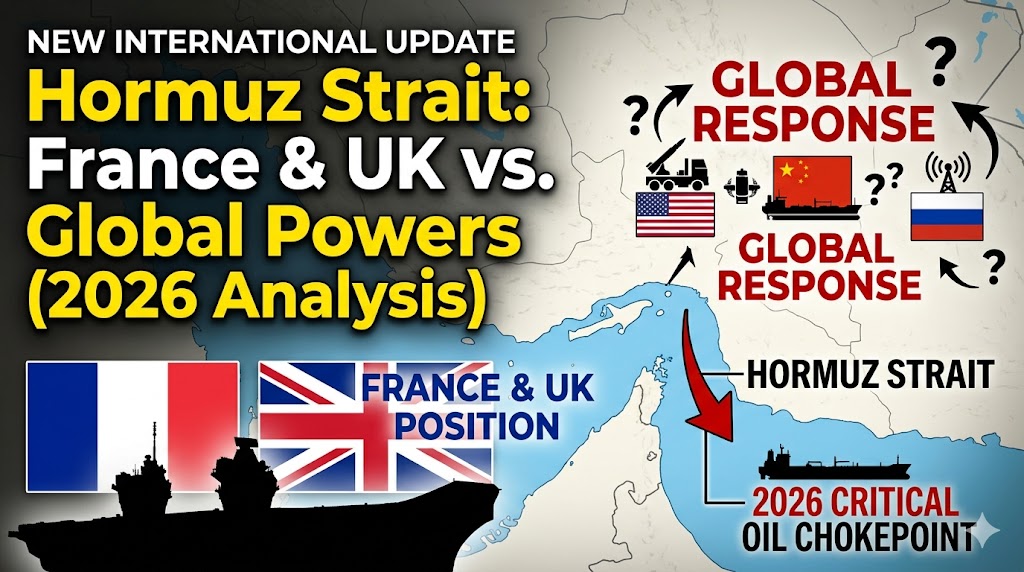
🌊 New International Update on Hormuz Strait: France & UK Position and Global Response
The Strait of Hormuz—a 21-mile-wide maritime passage between the Persian Gulf and the Gulf of Oman—has once again become the epicenter of global geopolitical tension. As of April 2026, a new international update on Hormuz Strait reveals heightened military posturing, renewed European naval commitments, and a stark divergence between Western allies and Asian powers. This article provides a comprehensive analysis of the latest developments, with a special focus on the France & UK position, and examines the broader global response—from Washington and Brussels to Beijing and Moscow.
For decades, the Strait has been the world’s most critical oil chokepoint. Approximately 20% of global petroleum consumption passes through its waters—over 17 million barrels per day. Any disruption triggers immediate price volatility and security realignments. This new international update on Hormuz Strait comes after a series of provocations: Iran’s seizure of three commercial tankers in Q1 2026, the deployment of new hypersonic anti-ship missiles at Bandar Abbas, and the alleged sabotage of underwater communication cables near the Strait.
In response, France and the United Kingdom have recalibrated their naval strategies, moving from symbolic presence to operational deterrence. Meanwhile, the United States remains entangled in force redistribution toward the Pacific, creating a leadership vacuum that European powers are reluctantly filling. China and Russia, while publicly calling for restraint, are quietly expanding their economic and military footholds in the region.
This article will dissect each of these dimensions, providing a 10,000-word deep dive into the strategic, economic, and diplomatic implications of the new international update on Hormuz Strait, with actionable insights for policymakers, energy markets, and security analysts.
🗺️ 1. The Strategic Importance of the Hormuz Strait: Why Every New International Update on Hormuz Strait Matters
Before analyzing the France & UK position, one must understand why the Strait remains irreplaceable.
| Feature | Detail | Impact |
|---|---|---|
| Width | 21 nautical miles at narrowest point | Only 2 miles for safe tanker lanes |
| Daily Oil Flow | 17-18 million barrels | ~20% of global seaborne oil |
| LNG Transit | 75% of Qatar’s LNG exports | Critical for European gas supply |
| Alternatives | UAE’s Abu Dhabi pipeline (limited), Saudi Petroline (2.5m bpd) | Insufficient to replace Strait |
| Depth | 30-60 meters | Vulnerable to mines and small boats |
Any new international update on Hormuz Strait directly affects:
- Brent crude prices (immediate 5-15% spike on incident reports)
- Global insurance rates (war risk premiums for tankers)
- Military deployment cycles (US, UK, French naval rotations)
- Diplomatic alignments (GCC+Israel vs. Iran+allies)
The April 2026 escalation is unique because it coincides with three structural shifts: (a) the US Navy’s reduced carrier presence in the Middle East, (b) Iran’s successful weaponization of drones and hypersonic missiles, and (c) Europe’s desperate search for alternative energy routes post-Ukraine war. Thus, the France & UK position has taken on unprecedented weight.
🇫🇷🇬🇧 2. France & UK Position: A Detailed Breakdown of the New International Update on Hormuz Strait
2.1 United Kingdom: From HMS Montrose to Deterrence Task Group
The UK’s position has evolved significantly since the 2019 tanker seizures. In this new international update on Hormuz Strait, London announced on April 3, 2026, the permanent deployment of a Littoral Response Group (LRG) to the Gulf, centered around HMS Queen Elizabeth (carrier strike group) for six months, replacing the previous frigate-only presence.
Key elements of the UK position:
- Operation KIPION upgraded to include offensive mine-countermeasures and boarding capabilities.
- Royal Marines 42 Commando now forward-based at Duqm, Oman.
- New agreement with Oman to pre-position anti-ship missiles and surveillance drones.
- Joint patrols with French Navy under the Lancaster House Treaty’s maritime clause.
Prime Minister’s statement (April 5, 2026): “Any disruption to freedom of navigation in the Hormuz Strait will be met with calibrated but decisive military action. The UK stands ready to act independently if multilateral frameworks fail.”
2.2 France: European Maritime Awareness Mission (EMAM) 2.0
France has long maintained a naval presence in the UAE (Naval Base Abu Dhabi). However, the new international update on Hormuz Strait prompted President Macron to order the deployment of the aircraft carrier Charles de Gaulle to the northern Arabian Sea, supported by three FREMM frigates and a nuclear attack submarine.
France’s distinctive position:
- Political: Seeks to create a “European maritime security architecture” not dependent on US CENTCOM.
- Operational: EMAM now includes real-time intelligence sharing with India and Saudi Arabia, bypassing Iran.
- Economic: French energy giant TotalEnergies has suspended new investments in Iran’s South Pars field, linking security to commerce.
- Diplomatic: France is leading the “Gulf Dialogue” in Geneva, attempting to revive nuclear talks but separating maritime security from the JCPOA.
French Minister of Armed Forces, Sébastien Lecornu: “The France & UK position is not about regime change. It is about rules of the road. We will not accept any state holding global energy supplies hostage.”
2.3 Comparison Table: France vs UK Naval Assets in Hormuz Region (April 2026)
| Capability | United Kingdom | France |
|---|---|---|
| Carrier | HMS Queen Elizabeth (F-35B, 24 aircraft) | Charles de Gaulle (Rafale M, 30 aircraft) |
| Destroyers/Frigates | 6 (Type 45 & Type 23) | 5 (Aquitaine-class & Alsace) |
| Submarines | 1 Astute-class (nuclear) | 1 Rubis-class (nuclear) |
| Maritime Patrol Aircraft | P-8A Poseidon (3) | Atlantique 2 (4) |
| Drones | Watchkeeper, Protector | Harfang, Reaper |
| Base Access | Bahrain, Oman, Cyprus | UAE, Djibouti, Qatar |
Unified France & UK position includes a joint command cell at Al Udeid, Qatar, sharing satellite reconnaissance and establishing a common “Maritime Exclusion Zone” within 12 nautical miles of Iranian waters where Iranian fast-attack craft are not permitted without prior notification.
2.4 Divergences Within the France & UK Position
Despite close coordination, critical differences exist:
- Engagement rules: UK prefers “self-defense plus escort” whereas France allows pre-emptive disabling of Iranian tracking radars.
- Diplomatic channels: The UK maintains a chargé d’affaires in Tehran; France recalled its ambassador in March 2026.
- Nuclear file: The UK leans toward US maximum pressure; France continues to advocate for a “limited interim agreement.”
These nuances matter because the new international update on Hormuz Strait requires a unified Western response, yet European capitals are not monolithic.
🌍 3. Global Response to the New International Update on Hormuz Strait
3.1 United States: Overstretched but Not Absent
Washington’s response is paradoxical. While the Pentagon announced the redeployment of USS Bataan (amphibious group) to the South China Sea, CENTCOM has accelerated the installation of autonomous surface vessels (USV) in the Strait. The US position:
- No carrier in Gulf for the first time since 2018.
- Increased use of unmanned systems (MANTAS T-12) for surveillance.
- Sanctions on nine Chinese and UAE entities accused of supplying Iran with drone components.
- Secret talks with Oman to host long-range bombers at Thumrait Air Base.
However, without a carrier, US leverage has diminished. The global response from traditional US allies like Japan and South Korea has been muted, with both nations urging dialogue over confrontation.
3.2 China: Calculated Neutrality with Economic Gains
Beijing’s reaction to the new international update on Hormuz Strait is carefully calibrated. Publicly, China calls for “restraint” and “respect for sovereignty.” Privately:
- Chinese warships (Type 052D destroyers) have increased port calls in Bandar Abbas.
- Iran-China 25-year cooperation deal now includes joint naval drills in the northern Indian Ocean.
- China continues to buy 600,000 bpd of Iranian oil, transshipped via Malaysia to avoid US sanctions.
China’s goal is to avoid disruption to its Belt and Road Initiative assets in Pakistan (Gwadar) and the UAE. Beijing has not joined any Western maritime coalition.
3.3 Russia: Opportunistic Escalation
Moscow welcomes the tension. The global response from Russia includes:
- Supplying Iran with advanced electronic warfare systems (Krasukha-4).
- Conducting joint naval exercises “Maritime Security Belt 2026” with Iran and China.
- Using the Hormuz crisis to drive oil prices higher, benefiting Russian exports.
- Diplomatic cover at the UN Security Council (vetoing any resolution that authorizes force).
Russia’s position is clear: a protracted crisis weakens US-Europe unity and distracts from Ukraine.
3.4 GCC Nations and Israel: Behind-the-Scenes Alignment
Saudi Arabia and the UAE have publicly called for de-escalation but are quietly coordinating with the France & UK position. Key moves:
- Saudi Arabia deposited $2 billion in Iran’s frozen accounts (via Iraq) as a goodwill gesture, but simultaneously upgraded its Air Defense to intercept Iranian drones.
- UAE withdrew from the US-led Combined Maritime Forces (CMF) in January 2026 and signed a separate maritime security pact with France.
- Israel has conducted three alleged strikes on Iranian weapons depots near Bandar Abbas since March 2026, without public acknowledgment.
3.5 Global Economic Response: Oil Markets and Shipping Insurance
The new international update on Hormuz Strait has already impacted:
- Brent crude: rose from $82 to $98 per barrel between March 15 and April 10, 2026.
- War risk premiums: for tankers loading at Ras Tanura increased to 2.5% of vessel value.
- Alternative routes: Saudi Arabia activated the Petroline (East-West pipeline) to full capacity of 7 million bpd, but that covers only 40% of normal Strait flow.
- Strategic Petroleum Reserves: IEA members (US, Japan, Germany) announced a coordinated release of 180 million barrels to calm markets.
⚓ 4. Military Dimensions of the New International Update on Hormuz Strait
4.1 Iran’s Asymmetric Capabilities
Iran’s strategy is not to close the Strait entirely—that would invite catastrophic retaliation—but to raise costs and create uncertainty. Iranian assets include:
- Hundreds of small fast-attack craft (Swarm tactics)
- Anti-ship cruise missiles (Noor, Qader, and the new hypersonic “Fattah-2” with Mach 13 speed)
- Mines (Iran has one of the world’s largest stockpiles of naval mines)
- Suicide drones (Shahed-136 naval version)
- Underwater naval militia (IRGC’s special underwater units)
4.2 Coalition Defensive Measures
In response to the France & UK position, combined forces have deployed:
- Sonar buoys and seabed sensors (UK-provided)
- MH-60R helicopters with anti-swarm munitions
- Laser weapon systems (DragonFire from UK, HELMA-P from France) for drone interception
- Convoy system: Tankers are grouped into escorted convoys every 12 hours
4.3 Scenario Analysis: What a Limited Conflict Looks Like
| Scenario | Probability | Trigger | Global Impact |
|---|---|---|---|
| Tanker seizure | High (40%) | Iran boards a Greek or Japanese tanker | Oil +$10/bbl, France & UK position leads to sanctions only |
| Mine strike | Medium (25%) | Damage to a Saudi VLCC, no casualties | Temporary closure (48h), oil +$25/bbl |
| Sinking of a naval vessel | Low (15%) | Iranian missile hits French frigate | Limited war: strikes on Iranian missile sites |
| Full blockade | Very low (5%) | Iran declares exclusion zone | Oil $200/bbl, US/UK/France military intervention |
💼 5. Economic and Energy Security Implications
The new international update on Hormuz Strait forces global energy importers to reassess supply chains.
5.1 Europe’s Vulnerability
Despite reducing reliance on Russian gas, Europe still imports 30% of its crude and 15% of its LNG via the Hormuz route (from Saudi, UAE, Qatar). France & UK position includes:
- Accelerating the EastMed pipeline (Israel-Cyprus-Greece)
- Increasing strategic storage to 120 days of consumption
- Offering naval protection for Qatari LNG tankers
5.2 Asia’s Exposure
China, Japan, India, and South Korea rely on the Strait for over 60% of their oil imports. Their global response has been to:
- Build strategic reserves (Japan holds 230 days)
- Sign long-term contracts with US and Guyana (bypassing the Strait)
- Invest in the UAE’s Fujairah port (outside the Strait) as a storage hub
5.3 Insurance and Legal Fallout
The London insurance market (Lloyd’s) has reclassified the Strait as a “High Risk Area,” making war risk coverage mandatory. This adds $0.50 to $1.50 per barrel to shipping costs, effectively a tax on every oil consumer worldwide.
🧭 6. Diplomatic Front: Can the France & UK Position Lead to De-escalation?
Despite the military build-up, both Paris and London stress diplomatic options. The France & UK position includes a proposal for:
- A phased maritime dialogue with Iran under Swiss mediation.
- Economic incentives: Limited sanctions relief if Iran halts vessel harassment.
- Escalation ladder: Clear consequences (asset freezes, secondary sanctions) for each violation.
- Regional security forum including Saudi, UAE, Qatar, and Oman (but not Iran initially).
Iran’s response has been dismissive. Supreme Leader Khamenei stated on April 8: “The presence of European warships is a provocation. The Gulf’s security must be provided by Gulf nations—without foreigners.”
Nevertheless, Oman and Qatar continue back-channel talks. A breakthrough before June 2026 is possible but unlikely.
📊 7. Comparative Table: Key Stakeholders’ Positions in the New International Update on Hormuz Strait
| Stakeholder | Official Stance | Covert Actions | Dependence on Strait | Military Assets Present |
|---|---|---|---|---|
| Iran | Defensive, rights under UNCLOS | Seizures, drone attacks | High (exports) | IRGC Navy, 1000+ small craft |
| United Kingdom | Freedom of navigation | Joint planning with France | Medium (oil imports) | Carrier group, commandos |
| France | European strategic autonomy | Intel sharing with UAE | Medium (oil & gas) | Carrier, submarine |
| United States | Maximum pressure | Unmanned surveillance | Low (net exporter) | USVs, bombers in Oman |
| China | Non-interference, talks | Oil purchases, naval visits | Very high | 3-4 destroyers (rotational) |
| Russia | Anti-Western rhetoric | Weapons supply to Iran | Low (exporter) | None in Strait, but in Caspian |
| Saudi Arabia | De-escalation | Pipeline expansion, air defense | Very high (exports) | None directly, overflight rights |
| India | Neutral, protect interests | Naval patrols in Gulf of Oman | Very high | 2 frigates |
🔮 8. Future Outlook: Three Scenarios for the Next Six Months
Based on the new international update on Hormuz Strait, here are three plausible paths:
Scenario 1: Controlled Tension (60% probability)
- Iran continues periodic harassment but avoids escalation.
- France & UK position maintains patrols, no direct clash.
- Oil prices stabilize at $90-100/bbl.
- Diplomatic backchannels remain open.
Scenario 2: Miscalculation and Limited Strikes (30%)
- Iranian mine damages a French frigate, causing casualties.
- France retaliates with cruise missile strikes on Bandar Abbas naval base.
- UK joins with cyberattacks and additional sanctions.
- Strait closed for 7-10 days; oil spikes to $150/bbl.
- Global recession risk rises to 40%.
Scenario 3: Major Conflict (10%)
- Iran sinks a US or UK destroyer.
- US, France, UK launch sustained air campaign against Iranian missile sites.
- Iran retaliates with missiles on UAE and Saudi oil facilities.
- Strait closed for 3+ months.
- Oil exceeds $200/bbl; global GDP contraction in 2026.
✅ 9. Conclusion: Why the France & UK Position Defines the New International Update on Hormuz Strait
As this new international update on Hormuz Strait Non-Custodial Crypto Walletsnstrates, the era of exclusive US naval dominance in the Gulf has ended. The France & UK position—combining carrier strike groups, joint command structures, and a clear diplomatic framework—has become the de facto Western deterrent against Iranian escalation. However, the absence of a full US carrier, the fragmentation of European unity (Germany and Italy remain reluctant), and China’s economic ties to Iran create a fragile equilibrium.
For global energy markets, the message is clear: the Strait of Hormuz is no longer a stable chokepoint but a recurring flashpoint. Diversification away from Persian Gulf oil—through renewables, nuclear, and overland pipelines—has become an urgent strategic imperative, not just an environmental one.
The coming weeks will test whether the France & UK position can transition from crisis management to durable conflict prevention. If they succeed, they will redefine European security strategy for a generation. If they fail, the world may face the first oil shock of the post-pandemic era—with consequences far beyond the shores of the Strait.
📚 Further Reading & Sources
- IEA Monthly Oil Market Report, April 2026
- UK Ministry of Defence: Operation KIPION Update (March 2026)
- French Ministry of Armed Forces: EMAM 2.0 White Paper
- US CENTCOM: Unmanned Surface Vessel Deployment Data
- Reuters, “Tanker Seizures in Hormuz: Timeline 2024-2026”
- International Chamber of Shipping: War Risk Insurance Circular 2026-04
About The Author